
Ruhr University Bochum and TU Dortmund University Celebrate Success in the Excellence Strategy
- Top News
- Research
- Studying & Teaching at TU Dortmund University
- Campus & Culture
- Higher Education Policy
- Press Releases

“We are overwhelmed by this outstanding achievement,” said Prof. Martin Paul, Rector of Ruhr University Bochum. “Together, we have moved up to the Champions League of science,” added Prof. Manfred Bayer, Rector of TU Dortmund University. The two universities had made a conscious decision to apply jointly in the Excellence Strategy in order to deepen their long-standing partnership. Under the name Ruhr Innovation Lab, they presented a concept designed to create an ecosystem for a future-proof society. It focuses on creative freedom for research, innovative teaching, close collaboration with business and society, and new models of cross-university cooperation.
Congratulations from the state government
Hendrik Wüst, Minister-President of the State of North Rhine-Westphalia: “Congratulations to the University of Cologne as well as to Ruhr University Bochum and TU Dortmund University, on this outstanding achievement. Both applications stood out in a research-based evaluation process against strong competition. This is wonderful news for the universities and for the State of North Rhine-Westphalia as a center of scientific excellence. The decision is a special achievement for our state and impressively demonstrates the strength and international influence of North Rhine-Westphalia as a hub for science. The Ruhr region, in particular, has developed in recent years into a strong and internationally visible hub for science and innovation. The Research Alliance Ruhr plays a key role in this development; as a central project of the Ruhr Conference, it brings together the world-class research of the University Alliance Ruhr. The new Consortium of Excellence builds on this strength and gives the Ruhr region as a center of science an additional boost. North Rhine-Westphalia is thus further expanding its outstanding position in the nationwide competition for excellence. Excellent research is an essential foundation for our state’s innovative strength. Both the scientific community and the business sector benefit from the strength of our universities, as do the hundreds of thousands of young people who study and conduct research in North Rhine-Westphalia. In an era of ever-accelerating technological change, it is our excellent universities that transform this change into new opportunities—opportunities for new, innovative products, for good jobs, and for prosperity and social security well into the future.”
Ina Brandes, Minister for Culture and Science of the State of North Rhine-Westphalia: “North Rhine-Westphalia is THE premier location for science and research in Germany. This claim is confirmed by its success in the Excellence Strategy. I would like to extend my warmest congratulations to the University of Cologne and the Ruhr Innovation Lab—a joint initiative of Ruhr University Bochum and TU Dortmund University—on their success. Together with the University of Bonn and RWTH Aachen University, this means that five universities in North Rhine-Westphalia will now rank among the world’s leading research institutions—more than in any other state. What the Ruhr Innovation Lab has built up in recent years is incredible. It shows that excellence is always possible when we seek to combine our strengths. The University of Cologne has fully deserved to regain its status of excellence. With five clusters of excellence, it is already one of Germany’s strongest research universities, and it will continue to build on this strength in the coming years. The Minister-President and I have closely supported the universities along this path and were on site during the visits conducted by the Excellence Strategy expert commission. We are all the more delighted by this success today. The success of our universities is a striking testament to cutting-edge research ‘made in NRW.’ In doing so, we are creating the best possible conditions for new insights, innovations, and solutions to the major challenges of our time—for the benefit of all people.”
A boost for the entire Ruhr Area
“Our credo is that science must not take place in an ivory tower, but must help shape solutions for society,” said Prof. Martin Paul. The joint research focal areas aim to secure prosperity for future generations, strengthen trust in the digital age, and safeguard the values of our democracy. The two universities are already conducting world-class research on topics such as sustainable chemistry, cybersecurity, AI-assisted materials design, and the nature of matter. By combining the complementary strengths of both institutions, the partnership also aims to address complex issues in areas such as mental health, the impact of media, and production technology.
“In our application, we built on a long-standing cooperation and are now taking the next step toward integration with the Ruhr Innovation Lab,” explained Prof. Manfred Bayer. The foundation is the University Alliance Ruhr, in which the two partners, together with the University of Duisburg-Essen, have created a wide range of joint structures since 2007, such as the shared Research Centers and the College. The Ruhr Innovation Lab is now testing an even closer bilateral partnership by gradually integrating services for research and knowledge transfer or by coordinating the personnel planning of pilot faculties.
“Our success in the Excellence Strategy will give the entire Ruhr Area a boost and greater international visibility,” the two rectors agree. It is still often overlooked that the Ruhr Area is one of Germany’s densest science regions, with over twenty universities and numerous non-university research institutions. A distinctive feature of the metropolitan area is the well-established collaboration across city boundaries—not only within the academic community but also with businesses and local governments. Consequently, the Ruhr Innovation Lab had strong regional partners at its side, such as the Initiativkreis Ruhr and the Regionalverband Ruhr.
Video Message from the Rectors
What contributed to the huge success in the Excellence Strategy? What does this funding mean for research at the two universities? And how do students actually benefit from it? In a video message, the two rectors reflect on the outcome.
Please confirm video activation.
After activation, cookies will be set and data is sent to YouTube (Google).
To the Google Privacy Policy
Impressions from the Announcement Ceremony
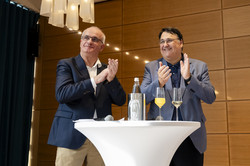
The suspenseful wait for the decision: At the Westfälischer Industrieklub in Dortmund, members of the Ruhr Innovation Lab watched the German Science and Humanities Council’s press conference live. There, the two rectors thanked all those who had been closely involved in the review process. Right in the middle of it all was the unicorn, which has turned out to be the consortium’s lucky charm.
-
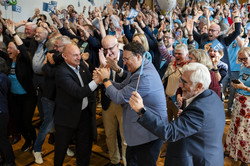
Dortmund Mayor Alexander Kalouti (left) and his Bochum counterpart Jörg Lukat (right) congratulate the rectors Manfred Bayer (second from left) and Martin Paul (second from right). -
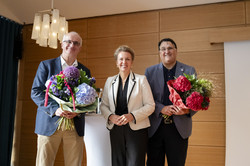
Science Minister Ina Brandes is also in attendance at the Westphalian Industrial Club, congratulating Manfred Bayer (left) and Martin Paul (right), as well as all members of the two universities. -

-

-
-
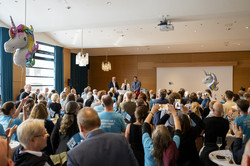
The unicorn has brought good luck to the Ruhr Innovation Lab.


Internal Town Hall Meeting
All members of Ruhr University Bochum and TU Dortmund University are invited to a digital town hall meeting on Wednesday, October 7, at 2:15 p.m. The two rectors will then provide information on the next steps and answer questions. The link to the webinar was sent via email to all employees and students.
About the Excellence Strategy
The Excellence Strategy of the federal and state governments is a competitive funding program designed to promote cutting-edge research at German universities; it was first launched in 2005 under the name “Excellence Initiative.” Universities that acquire a sufficient number of Clusters of Excellence may apply in a second funding line for the title of “University of Excellence” or “Consortium of Excellence.” The application requires a strategic concept that strengthens both the international competitiveness of the research and the organization’s capacity for structural renewal. An international jury evaluates the candidates on the basis of a written proposal and an on-site visit. Up to 15 spots were available for the seven-year funding phase beginning in 2027, for which ten defending institutions and eleven newcomers had applied. All funded institutions can be found on the website of the German Science and Humanities Council.
Contact person for queries:
Related news
Ruhr Innovation Lab Reviewed

Application as Consortium of Excellence Submitted

Ruhr Region Secures Three Clusters of Excellence in Tough Competition
