
Lectures Shed Light on Societal Challenges
- Top News
- Research
- Press Releases

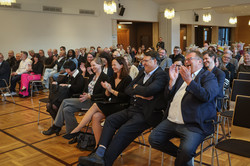
Prof. Manfred Bayer, President of TU Dortmund University, welcomed numerous guests from academia, industry and the civic community to the Westfälischer Industrieklub. He emphasized the societal relevance of the lectures and stressed that the Gambrinus Forum is intended to strengthen dialogue between academia and the civic community. He also noted that this exchange, like internationalization, is a cornerstone of the Ruhr Innovation Lab, the title under which TU Dortmund University and Ruhr University Bochum will be funded as a University Consortium of Excellence starting next year.
Why Loneliness Affects Us All
Loneliness is a feeling that almost everyone experiences at some point in their lives. In her lecture, the psychologist Prof. Maike Luhmann addressed who is affected by it, what consequences loneliness has and what can be done about it. Unlike being alone or social isolation, she explained, loneliness is a subjective and often painful feeling. Luhmann distinguished between emotional, social and collective loneliness. The psychologist gave a nuanced answer to the question of whether one can really speak of a “loneliness epidemic”: although young adults between 18 and 30 in particular have felt lonely more often since the coronavirus pandemic, loneliness was already widespread before it. Luhmann named drastic life events or experiences of discrimination as possible triggers. If loneliness persists over a long period, a so-called loneliness spiral can develop, which often harms both mental and physical health. Economic consequences, for example through absence from work, are also possible. To counter loneliness, she said, it is important to raise public awareness of the issue and to create opportunities for people to meet. Luhmann therefore stressed that loneliness is by no means only a private problem but also a political and societal task.
Prof. Maike Luhmann has been Professor of Psychological Methods at Ruhr University Bochum since 2016. Her research focuses in particular on loneliness, subjective well-being and personality development. Since 2022, she has been a member of the advisory board of the Kompetenznetz Einsamkeit (Loneliness Competence Network), and she regularly advises political institutions at national and European level.
How Biology and Culture Influence Anorexia
In her lecture, Prof. Beate Herpertz-Dahlmann spoke about the influence of biology and culture on anorexia nervosa. She showed that medicine long held misconceptions and false assumptions about anorexia, for example that sufferers deliberately refused to eat. Parents, too, were often held partly to blame for their children’s illness. From 2013 onwards, new classification criteria were finally developed with Herpertz-Dahlmann’s involvement, describing the characteristics of anorexia nervosa far more objectively and less arbitrarily. Medicine has since gained new insights: genetics, the brain, the gut microbiome and metabolism have a considerable influence on the onset and course of the illness. For example, as body weight falls, so does leptin, a hormone produced in fatty tissue. For evolutionary reasons, this lower leptin level leads to a strong urge to move. Understanding this connection is important for treatment, the expert said, because for a long time, people with anorexia were punished for excessive exercise. The physician sees a major problem in adolescents’ heavy use of social media, as social comparison on online platforms correlates with eating-disorder symptoms and algorithms further amplify the consumption of harmful content. Today, she said, social media use classified as risky can be observed in more than 20 per cent of adolescents. There are now new treatment approaches, co-developed by Herpertz-Dahlmann, that take a more holistic view, often involve caregivers and in some cases take place at home rather than as inpatient care.
Prof. Beate Herpertz-Dahlmann is a senior professor at RWTH Aachen University. A senior physician, she completed her habilitation on “Eating Disorders and Depression” and was appointed to Aachen in 1997, where she newly founded the Department of Child and Adolescent Psychiatry and Psychotherapy and served as its director until 2023. She was also President of the German Society for Child and Adolescent Psychiatry, Psychosomatics and Psychotherapy and a member of the DFG Review Board “Neurosciences”.
Internationalization Awards Presented in Four Categories
At the Gambrinus Forum, TU Dortmund University’s Internationalization Awards, each endowed with around 1,500 euros, were presented for the fifth time. Handing out the awards, Prof. Maximiliane Wilkesmann, Vice President International Affairs and Diversity, honored the recipients’ outstanding international commitment in research, teaching, transfer and administration.

The Dortmund Gambrinus Fellowships
Since 1993, the Gambrinus Fellowships have funded research stays by international researchers at TU Dortmund University. The fellowships were established in 1993 by the Association of Dortmund Brewers to mark the 700th anniversary of the city of Dortmund’s brewing rights. In total, more than 200 visiting researchers have been welcomed to Dortmund and numerous international collaborations established. With lectures by internationally renowned researchers, the annual Gambrinus Forum is aimed at a public beyond the university and has been held at the Westfälischer Industrieklub since 2016.
-
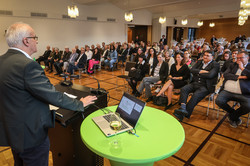
President Prof. Manfred Bayer welcomed guests to the event held at the Westfälischer Industrieklub. -
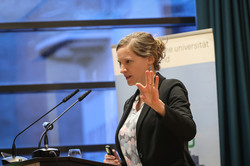
Prof. Maike Luhmann of Ruhr University Bochum spoke about her research on loneliness. -
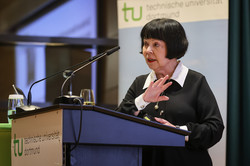
Prof. Beate Herpertz-Dahlmann of RWTH Aachen University presented her research on anorexia nervosa. -
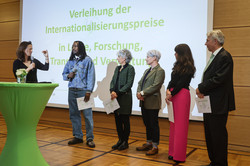
In a conversation with Prof. Maximiliane Wilkesmann (left), the recipients of the Internationalization Awards spoke about their award-winning projects and initiatives. -


Contact for queries: