
International UNESCO Chair Conference in Dortmund
- Top News
- Research

Every two years, the German UNESCO Chairs organize an international conference to report on their research in UNESCO’s major program areas. The event brings together representatives from science, education, politics and practice to discuss solutions to global challenges that should above all contribute to achieving the UN’s 17 Sustainable Development Goals (SDGs).
The title of this year’s conference, which focused on Southeast Asia, was “International Cooperation in Higher Education and TVET – Bridging the Gap Between Theory and Practice of SDGs.” Professor Thomas Schröder explained the choice of topic: “There are many clever ideas and concepts for coming a little closer to achieving the Sustainable Development Goals. However, implementing them in practice is often challenging. That is why we want to bridge this gap by intensifying international cooperation in higher education as well as in technical and vocational education and training.” The three-day conference, which attracted participants from Malaysia, Thailand, Indonesia, Cambodia, Brunei Darussalam, Vietnam, China and India, for example, as well as from numerous European countries, offered many opportunities for this.
Breadth of topics
On a personal level, Professor Thomas Schröder collaborates particularly closely with universities in East and Southeast Asia. His chair is working to advance research on vocational education and training policies and systems at national and international levels, placing a particular focus on work-based learning approaches as well as on training and continuing education for vocational teachers. To further develop vocational education and training systems worldwide, it fosters practice-oriented dialogue between academia and politics, in this way contributing to Sustainable Development Goal 4, “Quality Education”.
The conference agenda highlighted the breadth of topics addressed by the national and international UNESCO Chairs: Following the opening ceremony attended by the Mayor of the City of Dortmund and UNESCO representatives, among other guests (see below), three keynote speakers provided insights into digitalization in higher education and vocational training, transdisciplinary research on sustainable water management, and maintaining higher education in times of war. In numerous workshops, participants then dealt with topics such as sustainable urban development, the future of work, the circular economy, sustainability in education, politics of remembrance and cultural entrepreneurship.
Welcome addresses by national and international guests
The following guests gave welcome addresses at the opening ceremony: Professor Manfred Bayer, President of TU Dortmund University; Alexander Kalouti, Mayor of the City of Dortmund; Friederike Hansell, Head of the World Heritage Focal Point, UNESCO Section, at the Federal Foreign Office; Professor Christoph Wulf, Vice President of the German Commission for UNESCO; Professor Christine Volkmann and Professor Julius Heinicke, spokespersons for the German UNESCO Chairs; Dr. Sandra Garbade, President of the Federal Institute for Vocational Education and Training (BIBB); and Dr. Songheang Ai, Director of the Regional Center for Technical Education Development in the Southeast Asian Ministers of Education Organization (SEAMEO TED).
New UNEVOC Center
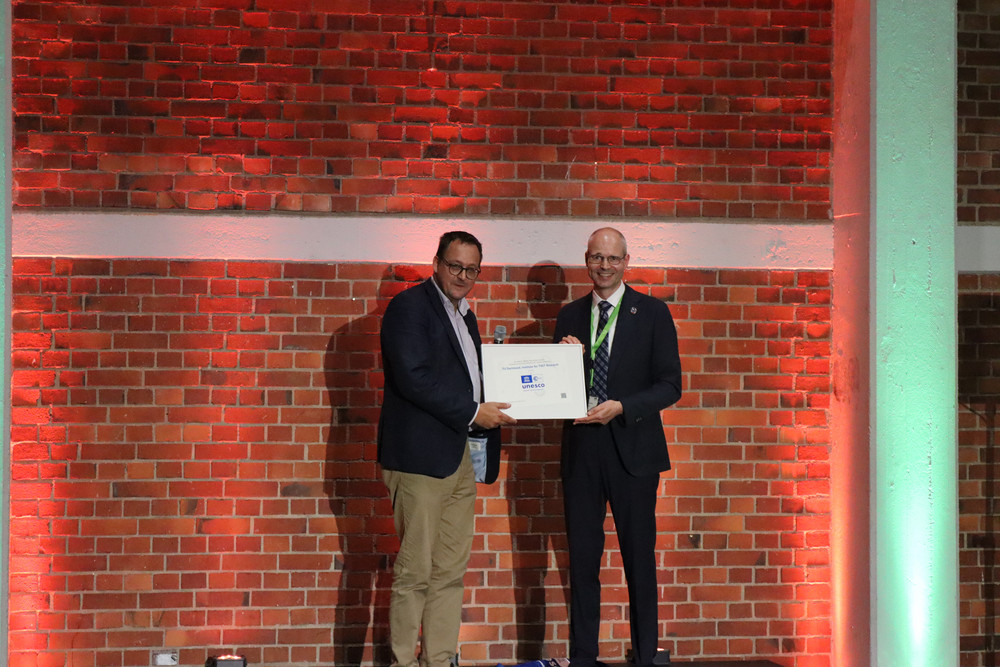
In October, the UNEVOC Center “Institute for TVET Research” was established at TU Dortmund University. During the conference, Dr. Friedrich Hübler (photo, right), Head of UNESCO-UNEVOC, presented Professor Philipp Grollmann (photo, left) with theNetwork Certificate, formally recognizing its membership as a UNEVOC Center. Grollmann has been Professor of Education in the Context of Work and Occupations at TU Dortmund University since 2023. At the UNEVOC Center, he will conduct research on national and international systems as well as innovations in vocational education and training in close cooperation with Professor Schröder’s UNESCO Chair. The centers’ mission is also to evaluate local policies and to develop skills by providing targeted training and continuing education programs as well as advisory services. TU Dortmund University is the first higher education institution in Germany to host both a UNESCO Chair and a UNEVOC Center.
Contacts for queries:
