
Hundreds of new ‘eyes’ buried in the Antarctic ice
- Particle Physics
- Top News
- Research
- Press Releases

The current upgrade is an important milestone on the path toward the future IceCube-Gen2 facility. It is expected to significantly increase sensitivity and open up new scientific opportunities. Researchers at TU Dortmund University are working closely with partners from Ruhr University Bochum in the IceCube consortium; the two universities are currently applying together as Ruhr Innovation Lab in the Excellence Strategy. A total of nine German universities and the two research institutes KIT and DESY are members of the consortium.

Hundreds of glass spheres 2,600 meters deep in the ice
The German partners have jointly contributed to the design, testing, and deployment of the new sensor technology. A pressure-resistant glass sphere, called a multi-PMT digital optical module (mDOM), houses multiple photomultiplier tubes (PMTs). These PMTs record the faint flashes of light produced when neutrinos occasionally interact with matter in the ice. The modules are deployed like pearls on a string: long cables carrying more than 100 devices were lowered into individual boreholes up to 2,600 meters deep. There, the ice serves as both the target and the detection medium for the ghostly cosmic particles. Alongside the new optical modules, the upgrade also included new calibration devices and cameras. These instruments provide controlled reference measurements and in-situ monitoring, which helps characterize the optical properties of the ice and the detector response under real operating conditions more accurately.
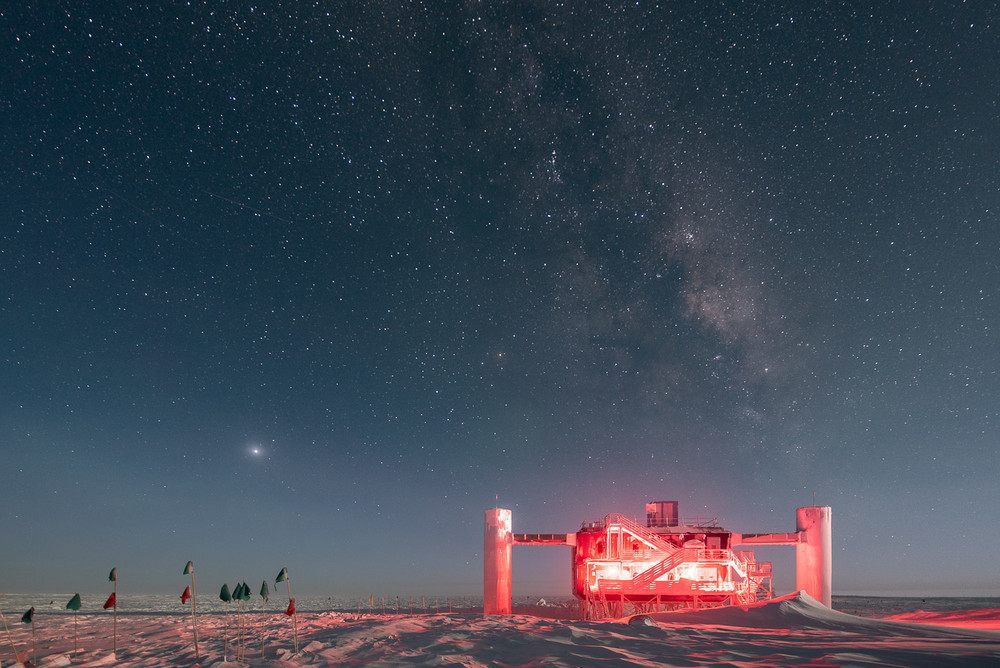
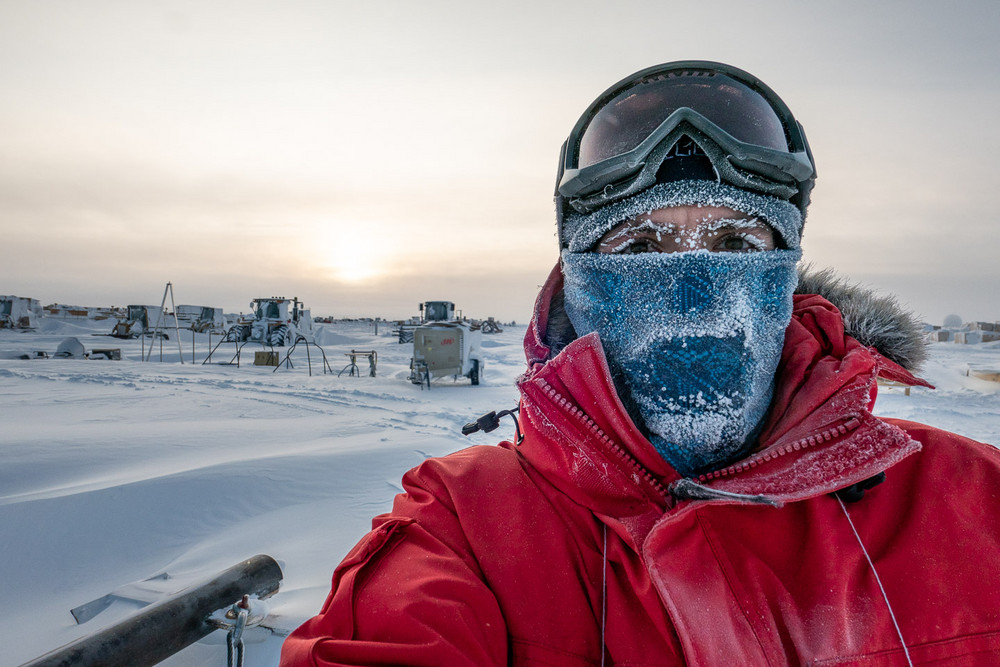
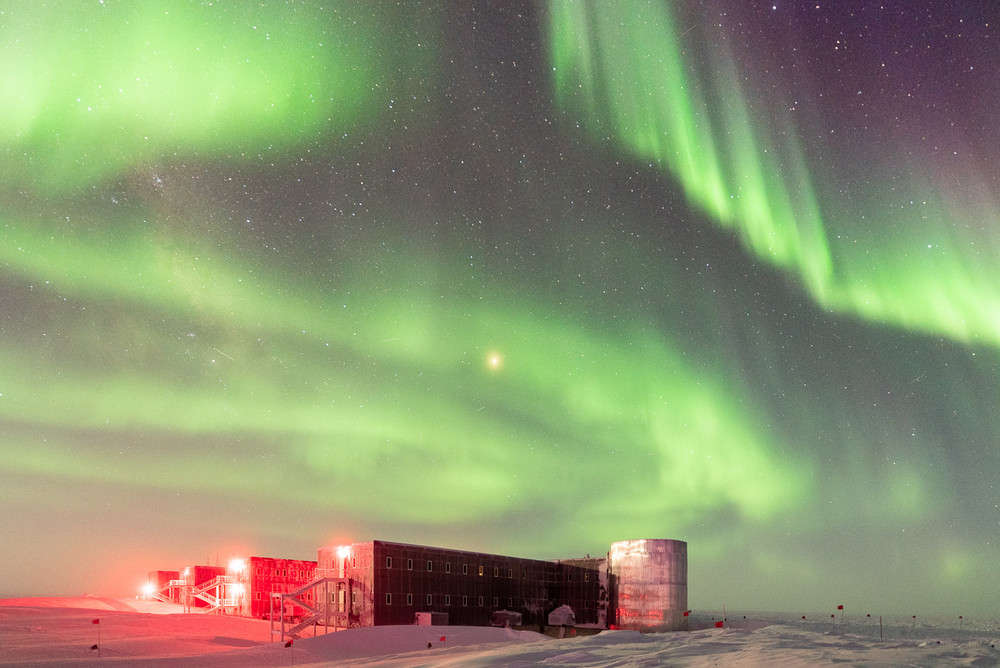
Around five thousand PMTs were tested and calibrated at TU Dortmund University as part of Johannes Werthebach’s Ph.D. thesis before being forwarded for integration and assembly into complete mDOMs. Scientists from Ruhr University Bochum contributed to improving the ice characterization through a new camera system. TU physicist Johannes Werthebach and Dr. Alicia Fattorini participated in the deployment at the South Pole. Werthebach worked specifically on the upgrade and supported critical installation steps, such as freezing the glass modules in the boreholes. Fattorini, an IceCube winterover, helped ensure the observatory's continuous year-round operation under extreme conditions.
Looking ahead, the newly installed calibration devices and camera systems will reduce systematic uncertainties and improve the reconstruction of neutrino events. These improvements will enhance future measurements and enable the improved reconstruction and reanalysis of the complete IceCube data set already collected. This will strengthen IceCube’s overall physics reach and lay important groundwork for the next-generation IceCube-Gen2 observatory.
About the Ruhr Innovation Lab
Ruhr University Bochum and TU Dortmund University, which currently apply together as the Ruhr Innovation Lab in the Excellence Strategy, work closely on issues that help to develop a sustainable and resilient society in the digital age. At the same time, collaborations in basic research are opening up new insights into the building blocks of our world.
Neutrinos emerge from various kinds of nuclear reactions. They are nearly massless, carry no electrical charge, and only very rarely interact with matter. However, within the last decades, scientists have figured out ways to detect neutrinos using massive amounts of dense material – such as the ice sheet of the Antarctic – learning much about the particles. When neutrinos interact with matter, a heavier partner particle emerges, as well as a brief flash of light. Scientists use photomultiplier tubes (PMTs) to amplify the light into electrical signals that can be detected. By this method, neutrino observatories around the world have made these ghostly particles into messengers that relay information about distant regions of the cosmos.
Related news
TU-Forscher*innen an internationalen Großprojekten beteiligt

IceCube discovers neutrinos from the Milky Way

Physicist of TU Dortmund University back after one year in the eternal ice
